Tech
We summarize the week's scientific breakthroughs every Thursday.
- Science & Society
The truth about brain rot, according to science
Emerging research suggests overusing digital devices can be harmful, especially to mental health. But does being overly online truly rot our brains?
- Health & Medicine
A blood test for dementia may tell you if you have more than one type
AI helped researchers develop an experimental blood test that might let doctors diagnose overlapping dementias.
- Math
AI cracked an Erdős math problem. Now experts want guardrails
The result is correct but challenges core norms of mathematics: checking proofs, crediting ideas and keeping research open to everyone.
- Quantum Physics
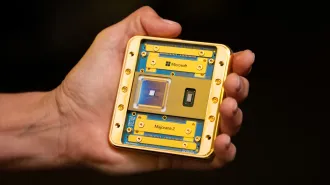
Microsoft’s quantum chip got an upgrade. Critics are still skeptical
Swapping materials in its Majorana 2 chip boosted the effectiveness of quantum bits that rely on the math of topology to reduce errors, Microsoft says.
- Artificial Intelligence
AI bots ignore evidence. Can we trust them with science?
Scientists rethink their ideas after experiments. AI agents struggle to learn from evidence and recognize when an idea is obviously incorrect.
- Animals
AI-powered whale-spotting tech may help save San Francisco Bay’s gray whales
An AI trained to use thermal images to detect whale body heat could help warn ships at risk of colliding with the marine mammals.
- Science & Society
AI can take the friction out of life, but some effort can be good
Technologies, including chatbots, promise to make life easier. But removing the friction, or effort involved in thinking, has costs.
- Neuroscience
25 people learned to fly with virtual wings. Here’s how the brain changed
A new study shows learning to fly in virtual reality with virtual wings can reshape the brain, making it treat wings more like body parts.
- Health & Medicine
Can AI help doctors avoid missed diagnoses? A new study suggests yes
AI may help doctors avoid missed diagnoses, but it still needs real-world testing and human oversight before it can guide patient care.
- Math
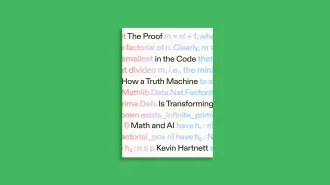
The Proof in the Code traces efforts to digitally verify mathematical truths
Journalist Kevin Hartnett chronicles how code-checking tools and AI are being used to tackle difficult math problems.
- Artificial Intelligence
Is AI bad for critical thinking? It depends on when you use it
Using AI later in solving tough problems boosts critical thinking and memory, a study shows, highlighting trade-offs between speed and reasoning.
- Artificial Intelligence
Welcome to the weird world of AI agent teams
AI agents are starting to work in teams, but without careful organization, groups of bots can easily fall into chaos.