Space
We summarize the week's scientific breakthroughs every Thursday.
- Astronomy
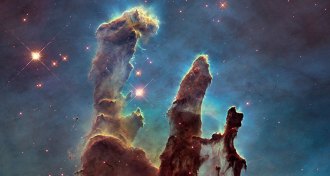
Magnetic fields may be propping up the Pillars of Creation
Scientists made a map of the magnetic field within the Pillars of Creation, a star-forming area depicted in an iconic Hubble Space Telescope image.
- Astronomy
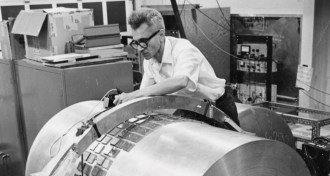
In 1968, scientists thought they were close to detecting gravity waves
Despite an unverified discovery in 1968, spacetime ripples remained elusive for nearly 50 years.
- Astronomy
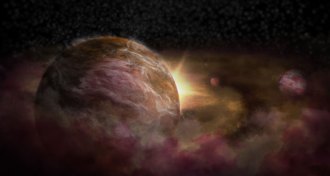
Swirling gases reveal baby planets in a young star’s disk
A new technique pinpointed three planets forming around a young star about 330 light-years from Earth.
- Planetary Science
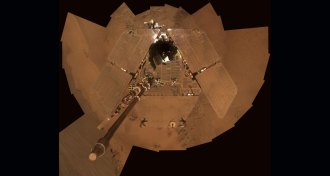
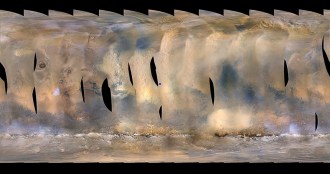
The Mars rover Opportunity is sleeping, not dead, NASA says
Opportunity is hunkered down in a deep sleep on Mars to ride out what’s looking to be a long dark dust storm.
- Astronomy
Readers were curious about pendulum saws, laser tweezers and more
Readers had questions about Bronze Age pendulum saws, dark matter, lazer tweezers and more.
- Planetary Science
Opportunity rover waits out a huge dust storm on Mars
NASA’s Opportunity rover is in low-power mode to preserve battery life while a vast dust storm blankets part of the Red Planet.
- Astronomy
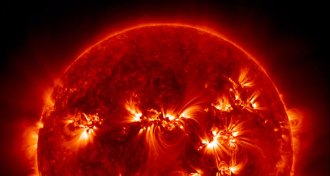
The sun shrinks a teensy bit when it’s feeling active
The radius of the sun gets slightly smaller during periods of high solar activity, researchers say.
- Planetary Science
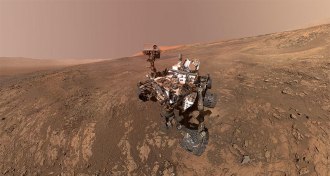
Curiosity finds that Mars’ methane changes with the seasons
The Curiosity rover found seasonally changing methane in Mars’ atmosphere and more signs of organic molecules in an ancient lake bed.
- Particle Physics
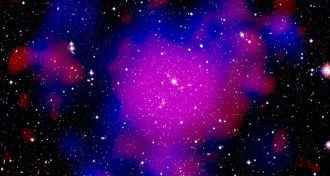
If real, dark fusion could help demystify this physics puzzle
Fusing dark matter particles might explain why galaxy cores have evenly distributed dark matter.
- Planetary Science
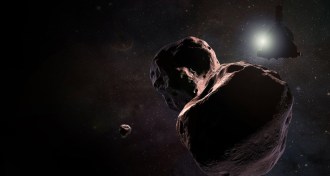
New Horizons wakes up to begin Kuiper Belt exploration
The New Horizons spacecraft just woke up to get ready for its New Year’s Day flyby of the distant space rock Ultima Thule.
- Astronomy
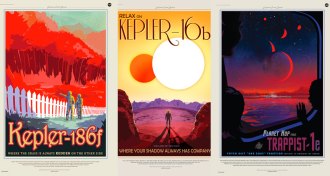
Take a virtual trip to an alien world
NASA’s Exoplanet Travel Bureau website lets you view what alien landscapes might look like.
- Astronomy
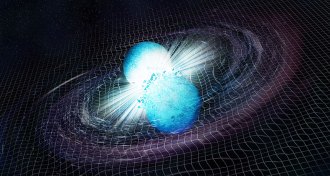
A neutron star crash may have spawned a black hole
The neutron collision that took the astronomical community by storm last year probably created a black hole, researchers say.