Space
We summarize the week's scientific breakthroughs every Thursday.
- Astronomy
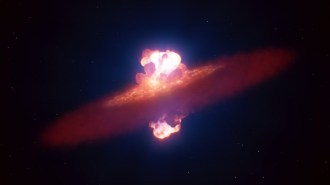
New Hubble images may solve the case of a disappearing exoplanet
A massive collision between two asteroid-sized bodies around a nearby star offers a rare look at the violent process of planetary construction.
- Astronomy
A new hunt for an Earth analog begins
The Terra Hunting Experiment will track the wobbles of dozens of stars nightly for years in the most focused hunt yet for an Earth twin.
- Astronomy
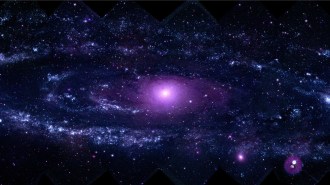
Dark matter ‘nuggets’ could explain the Milky Way’s mysterious glow
A mysterious excess of far-ultraviolet light seen across the Milky Way could come from the annihilation of clumpy dark matter.
- Life
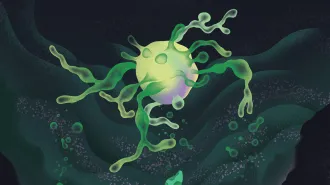
How these strange cells may explain the origin of complex life
The tiny pantheon known as the Asgard archaea bear traits that hint at how plants, animals and fungi emerged on Earth.
- Planetary Science
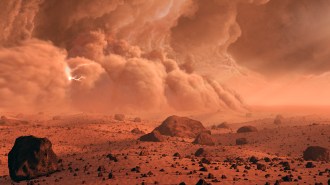
Listen to the crackle of Martian ‘mini-lightning’
A microphone on NASA’s Perseverance rover recorded the sounds of electrical discharges generated by dusty gusts.
- Planetary Science
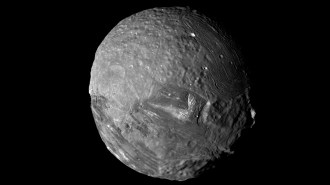
Boiling oceans may sculpt the surfaces of small icy moons
Simulations show that subsurface oceans on small moons may hit boiling conditions, potentially creating features like Miranda’s distinctive ridges.
- Space
America risks losing its role as a space science pioneer
Funding uncertainties are pushing U.S. space scientists out of the field and putting existing and future space missions on the chopping block.
- Astronomy
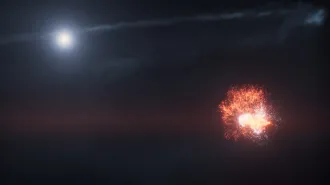
Early views of a supernova’s first moments reveal a lopsided blast
Some of the earliest images ever taken in the wake of massive star’s death give astronomers important clues about what triggers a supernova.
- Planetary Science
How did Pluto capture its largest moon, Charon?
Planetary scientist Adeene Denton runs computer simulations to investigate Pluto, the moons of Saturn and other icy bodies in the solar system.
- Astronomy
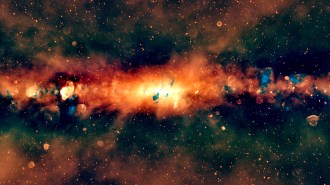
See the largest, most detailed radio image of the Milky Way yet
Supernova remnants, stellar nurseries and more populate the new edge-on view of the Milky Way as seen from Earth’s southern hemisphere.
- Astronomy
Some planets might home brew their own water
Tests on olivine hint that water-rich exoplanets could generate H2O internally, possibly explaining ocean worlds and even some of Earth’s early water.
- Space
Black holes are encircled by thin rings of light. This physicist wants to see one
Theoretical physicist Alex Lupsasca is pushing for a space telescope to glimpse the thin ring of light that is thought to surround every black hole.