Space
We summarize the week's scientific breakthroughs every Thursday.
-
- Space
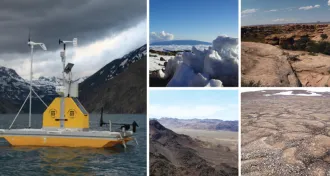
Exploring Earth’s alien spaces
Nathalie Cabrol, a planetary geologist and astrobiologist at the SETI Institute’s Carl Sagan Center and NASA’s Ames Research Center, both in Mountain View, Calif., hunts for alien life.
- Cosmology
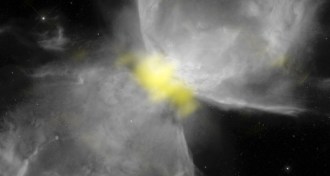
Huge Galactic Explosion
An excerpt from the October 5, 1963, issue of Science News Letter.
- Planetary Science
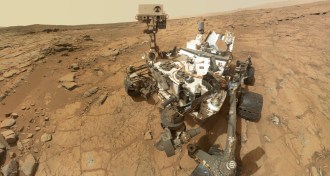
Mars rover fails to find methane
A dearth of the gas in the Red Planet's atmosphere disappoints scientists looking for signs of biological activity.
- Planetary Science
Cometlike crashes produce building blocks of life
Amino acids in collision residue support importance of extraterrestrial impacts.
-
- Astronomy
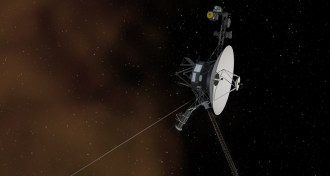
At last, Voyager 1 slips into interstellar space
Solar blast data provides definitive evidence that Voyager 1 has cruised beyond the heliosphere and into interstellar space.
- Astronomy
Radio telescope images reveal nebula’s heart of carbon
ALMA takes detailed look at elements surrounding dying star.
- Astronomy
The sun’s older twin, 250 light-years away
Almost twice as ancient, the distant star gives a glimpse of the sun's future.
- Planetary Science
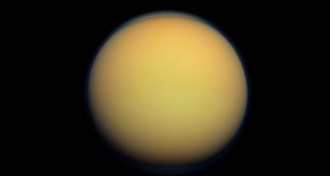
Titan becomes even more enigmatic
Thick, rigid crust of ice encases Saturn's largest moon, perplexing scientists.
- Earth
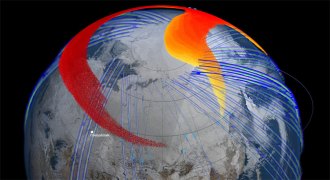
Map tracks path of dust plume from Chelyabinsk meteor
Satellite data capture how the jet stream pushed particles through the planet's atmosphere.
- Planetary Science
Shergottite SHER-goh-tite n.
Shergottite is the most common kind of Martian meteorite.