Space
We summarize the week's scientific breakthroughs every Thursday.
- Astronomy
Sun’s sibling spotted
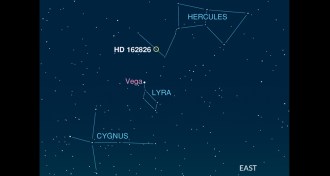
A nearby star may have come from the same birth cluster as the sun; learning how to find other solar siblings could point the way to their common origin.
- Cosmology
The mysterious boundary
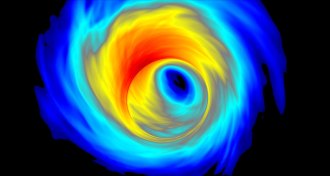
A debate has arisen over whether an astronaut passing a black hole’s point of no return would get stretched to death or flash-fried. Resolving the controversy may lead to new insights about gravity and more.
- Cosmology
Revamping the size of the universe
Despite new telescopes and technology, no one knows whether the universe is infinitely large or even if what has been observed is the only universe that exists.
- Astronomy
Milky Way’s far side reveals some secrets
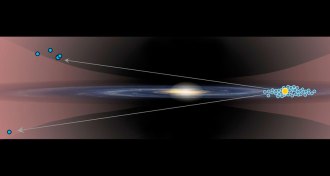
Variable stars provide first direct measurements of distance to the far side of the Milky Way.
- Astronomy
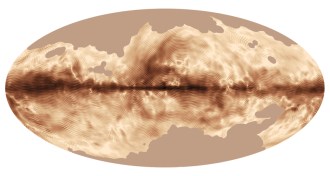
Milky Way’s magnetic field mapped
The Planck telescope sees the galaxy’s magnetic field in polarized light bouncing off interstellar dust grains.
- Cosmology
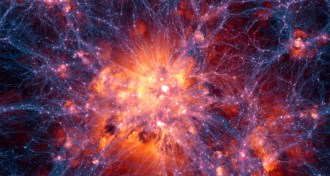
Universe re-created in computer simulation
The Illustris Project traces the detailed evolution of the universe starting from 12 million years after the Big Bang.
- Cosmology
See the sky in a different light
An interactive map lets you explore the galaxy with infrared light.
- Astronomy
Illuminating a dark universe
The film "Dark Universe" compresses a century of discovery into a crisp, comprehensible half hour.
-
- Planetary Science
The ice of a distant moon
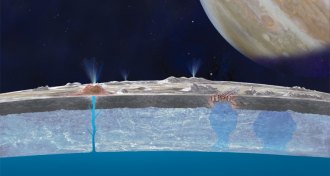
Jupiter’s moon Europa hides a liquid ocean, and conceivably life, under kilometers of ice. The challenge for engineers is how to penetrate that frozen barrier with technology that can be launched into space and operated remotely.
- Astronomy
Exoplanet spin measured for first time
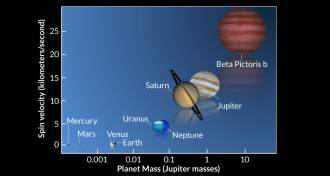
Astronomers measure the spin of a planet outside our solar system, and its days are short: just over eight hours.
- Astronomy
Chilly starlike orb found just a few light-years away
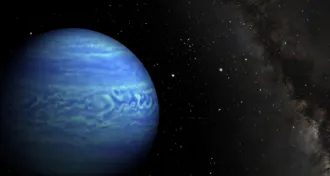
WISE J085510.83-071442.5 is the coldest brown dwarf found to date.