Space
We summarize the week's scientific breakthroughs every Thursday.
- Planetary Science
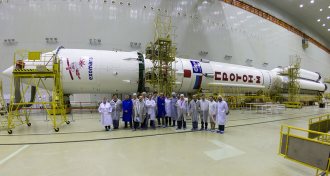
ExoMars mission to search for signs of life on the Red Planet
The next mission to Mars will tally gases in the planet’s atmosphere and test technologies for a 2018 rover.
- Astronomy
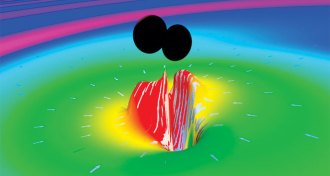
Black hole smashup generated yottawatts of power
For a split second, LIGO’s black hole collision generated 36 septillion yottawatts of power, or 50 times the power from all the stars in the universe.
- Neuroscience
Readers respond to stress, tattoos, and the universe
Stress, tattoos, cosmic origins and more reader feedback.
- Planetary Science
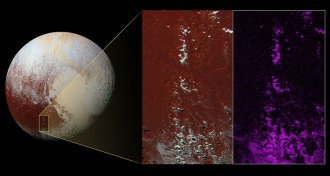
Mountains on Pluto are a winter wonderland of methane snow
On Pluto, methane snow blankets mountain tops.
- Planetary Science
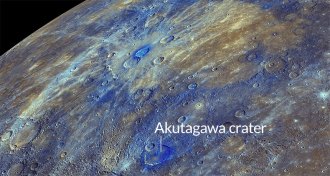
Mercury’s dark secret revealed
Graphite from Mercury’s primordial crust might be responsible for making the innermost planet darker than the moon.
- Astronomy
A fast radio burst’s home galaxy may not be known after all
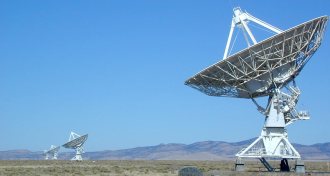
The recently claimed host galaxy of a fast radio burst may have been signs of a snacking black hole instead, study claims.
- Astronomy
Repeating fast radio bursts recorded for the first time
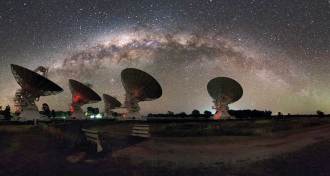
Until now, ephemeral blasts of radio waves from other galaxies have never repeated; this one erupted 10 times last year.
- Astronomy
Astronauts set to return to Earth after nearly a year in space
Scott Kelly and Mikhail Kornienko are scheduled to return Earth on Tuesday after a record-setting 340 days in space.
- Planetary Science
Charon’s surface cracked when ancient subsurface sea froze
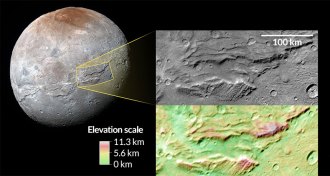
A subsurface ocean on Charon, Pluto’s largest moon, might have once frozen and cracked the moon’s surface, creating some of the ridges and valleys seen today.
- Astronomy
Fast radio burst tracked to its galaxy of origin
After years of searching, astronomers finally track an elusive cosmic radio signal to its home: a galaxy about 6 billion light-years away.
- Cosmology
Celebrating a new way to listen to the universe
Editor in Chief Eva Emerson reflects on the detection of gravitational waves as a historic moment for physics.
- Chemistry
After 75 years, plutonium is still NASA’s fuel of choice
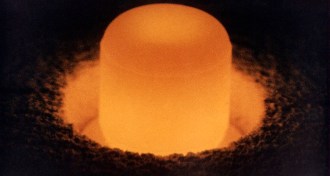
On the 75th anniversary of the discovery of plutonium, the radioactive element is still not a major source of fuel for nuclear power plants in the United States.