Space
We summarize the week's scientific breakthroughs every Thursday.
- Astronomy
Can the eclipse tell us if Einstein was right about general relativity?
During the eclipse, astronomers will reproduce the 1919 experiment that confirmed Einstein’s general theory of relativity.
- Astronomy
What can we learn about Mercury’s surface during the eclipse?
Instruments aboard twin research jets will take advantage of the total solar eclipse to make the first thermal map of Mercury.
- Astronomy
What happens in Earth’s atmosphere during an eclipse?
The charged layer of Earth’s atmosphere gets uncharged during an eclipse, and that could have implications for everything from GPS accuracy to earthquake prediction.
- Astronomy
What do plants and animals do during an eclipse?
A citizen science experiment will gather the biggest dataset to date of animal responses to a total eclipse.
- Astronomy
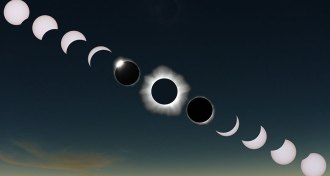
What will scientists learn from the Great American Eclipse?
Between now and August 21, astronomy writer Lisa Grossman will explore the top questions scientists will tackle during the 2017 total solar eclipse.
- Astronomy
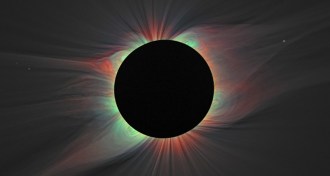
Why is this year’s solar eclipse such a big deal for scientists?
Total eclipses offer scientists a way to see all the way down to the sun’s surface.
- Planetary Science
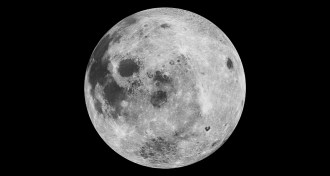
Moon had a magnetic field for at least a billion years longer than thought
The moon’s magnetic field could have lasted until about a billion years ago.
- Astronomy
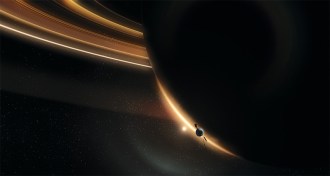
Nostalgic Voyager documentary relives first exploration of the solar system
A new TV documentary is a tender tribute to Voyagers 1 and 2, which launched 40 years ago and were the first spacecraft to visit the outer solar system.
- Planetary Science
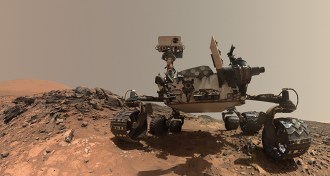
What Curiosity has yet to tell us about Mars
Curiosity has revealed a lot about Mars in the last five years. But NASA’s rover still has work to do on the Red Planet.
- Astronomy
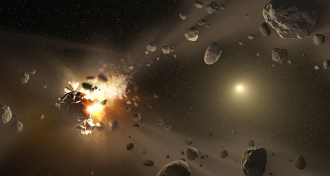
The solar system’s earliest asteroids may have all been massive
A team of astronomers says the original asteroids all came in one size: extra large.
- Science & Society
Your solar eclipse experience can help science
The Aug. 21 total solar eclipse offers a rare opportunity for crowdsourced data collection on a spectacular celestial phenomenon.
- Planetary Science
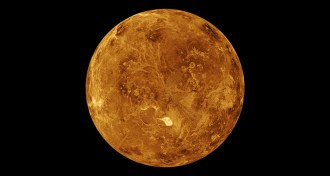
Evidence mounts for an ocean on early Venus
Not long after its birth, Venus may have rocked a water ocean, new simulations suggest.