Physics
We summarize the week's scientific breakthroughs every Thursday.
- Climate
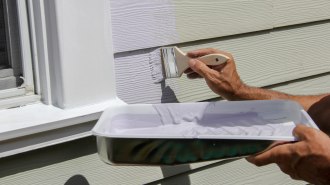
This paint ‘sweats’ to keep your house cool
This experimental paint reflects sunlight, emits heat and mimics sweating to cool buildings without air conditioning, even in the tropics.
- Space
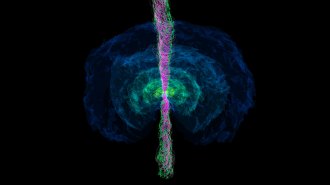
Here’s how a collision of star remnants launches a gleaming jet
A computer simulation shows how two neutron stars of unequal mass merge, form a black hole and spit out a jet of high energy matter.
- Physics
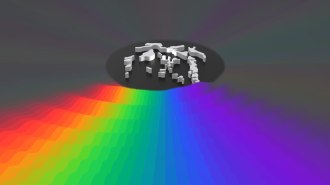
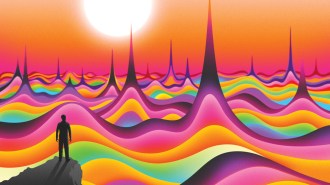
Rainbows of sound are a reality thanks to a new device
A plastic structure separates white noise into pitches, like a rainbow splits light into colors, offering a novel way to manipulate sound.
- Computing
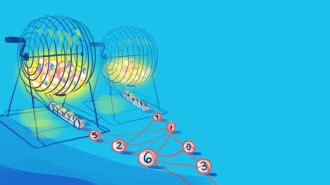
There’s no cheating this random number generator
From jury duty to tax audits, randomness plays a big role. Scientists used quantum physics to build a system that ensures those number draws can’t be gamed.
- Physics
How to get the biggest splash at the pool using science
Move over belly flops and cannonballs. Manu jumps, pioneered by New Zealand’s Māori and Pasifika communities, reign supreme.
- Particle Physics
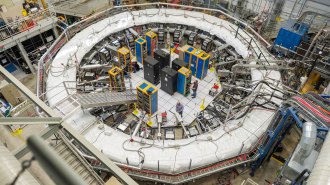
Muons’ magnetism matches theory, easing an enduring physics conundrum
A puzzle over muons’ magnetic properties could have broken the standard model. But the theory bounced back.
- Science & Society
Trump’s ‘Golden Dome’ plan has a major obstacle: Physics
Scientists suggest the missile defense plan will face big hurdles, especially given its projected timeline and cost.
- Physics
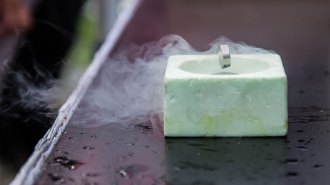
Scientists used a levitating magnet to hunt for dark matter
The quantum-based magnet technique could allow scientists to spot ultralight dark matter particles.
- Quantum Physics
The unsung women of quantum physics get their due
The new book, Women in the History of Quantum Physics, spotlights the oft-forgotten contributions of women scientists in the field.
- Quantum Physics
As quantum mechanics turns 100, a new revolution is under way
With greater control over the quantum realm, physicists are poised to make major leaps in quantum computing, quantum gravity and more.
- Tech
New audio tech could let you listen privately without headphones
Private listening out in the open is possible thanks to acoustic metasurfaces that precisely bend and direct sound waves.
- Plants
A leaf’s geometry determines whether it falls far from its tree
Shape and symmetry help determine where a leaf lands — and if the tree it came from can recoup the leaf’s carbon as it decomposes.