Physics
Twisted stacks of 2-D carbon act like a weird type of superconductor
“Magic-angle” graphene may provide new clues into poorly understood unconventional superconductors, which operate at higher-than-normal temperatures.
Every print subscription comes with full digital access
“Magic-angle” graphene may provide new clues into poorly understood unconventional superconductors, which operate at higher-than-normal temperatures.
We summarize the week's scientific breakthroughs every Thursday.
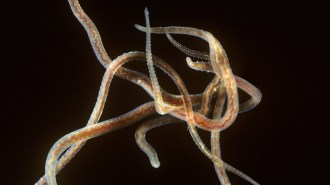
Ammolite gems’ fabulous colors arise from delicate assemblies of crystal plates.
Streams of liquid form drops thanks to unidentified disturbances. It could be the jiggling of individual molecules.
Math and physics explain the anguish of a golf ball that zings around the rim of the hole instead of falling in.
Theoretical physicist Alex Lupsasca is pushing for a space telescope to glimpse the thin ring of light that is thought to surround every black hole.
With a high-speed camera and a tiny guillotine, scientists showed that chopping onions slowly and with sharper knives cuts down on tears.
Google says its quantum computer achieved a verifiable calculation that classic computers cannot. The work could point to future applications.
At an effective temperature of 13 million kelvins, the jiggling glass sphere could help scientists understand physics at the microscale.
By weaving Kevlar or polyethylene nanofibers into standard neoprene in wetsuits, researchers found ways to limit injury during rare encounters with sharks.
The advance hints at the possibility of portable muon-making devices that could help peer through solid materials for hidden contraband.
Subscribers, enter your e-mail address for full access to the Science News archives and digital editions.
Not a subscriber?
Become one now.