Health & Medicine
- Health & Medicine
Test Ebola treatments to be rushed to West Africa
The World Health Organization has announced that it will use test treatments in West Africa starting this fall.
- Genetics
A story about why people get fat may be just that
In this issue, reporters look at efforts to find the genes that could be responsible for the obesity crisis and how evolution acts on diseases such as Ebola and tuberculosis.
- Genetics
Ancient famine-fighting genes can’t explain obesity
Scientists question the long-standing notion that adaptation — specifically the evolution of genes that encourage humans to hold on to fat so they can survive times of famine — has driven the obesity crisis.
- Health & Medicine
Trial drug improves heart failure patients’ chance of survival
Novartis’ experimental therapy LCZ696 lowers blood pressure and increases survival rates when compared with a standard drug.
- Health & Medicine
A hungry brain slurps up a kid’s energy
Compared with other animals, human children take their time growing up. A new study suggests that’s because kids’ brains burn a lot of energy, perhaps diverting resources from their growing bodies.
- Health & Medicine
Removing both breasts may not boost cancer survival
Women diagnosed with cancer in one breast who choose to have both breasts removed may not have better survival rates than women who opt for breast-conserving surgery and radiation.
- Health & Medicine
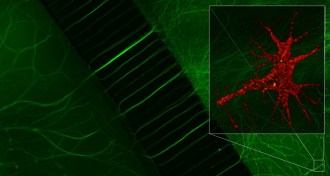
Rabies races up nerve cells
By hijacking a transporter protein and hitting the gas, the disease-causing rabies virus races up long nerve cells that stretch through the body, a new study finds.
- Health & Medicine
Tiny mites are probably crawling all over your face
Two skin mites, relatives of spiders, might populate the faces of all adult humans, according to a DNA survey.
- Life
ZMapp drug fully protects monkeys against Ebola virus
In a test, 18 monkeys injected with the Ebola virus and treated with an experimental drug called ZMapp survived.
- Health & Medicine
Babies may be good at remembering, and forgetting
Studies in kids suggest that young children can form memories but can’t recall them later, offering new clues to how memory-storing systems form in young brains.
- Genetics
Ebola genome clarifies origins of West African outbreak
Genetic analyses suggest that a single infected person sparked the ongoing Ebola epidemic in West Africa.
- Health & Medicine
Human tests of experimental Ebola vaccine set to start
NIH and NIAID have announced that human tests of an experimental vaccine against Ebola virus will begin in early September.