Earth
We summarize the week's scientific breakthroughs every Thursday.
- Life
Microbes flourish under Arctic sea ice
Oceanographic expedition surprised to find photosynthetic microorganisms thriving under frozen surface.
- Tech
Court ‘shares’ researchers’ e-mails, intellectual property
“A situation has arisen involving scientists at the Woods Hole Oceanographic Institution (WHOI) that should concern all those who value the principles of academic freedom and responsibility,” warns top WHOI officials. They were responding to a court order requiring that two WHOI scientists turn over 3,500 emails and other documents to BP. Included in the information was intellectual property that outsiders could exploit.
- Earth
Arctic’s wintry blanket can be warming
Forested snowscapes keep northern soils relatively toasty, diminishing how much climate-warming carbon they can sequester from the atmosphere.
- Life
Ancient birds wiped out huge insects
Competition in the air trumped the advantage of extra atmospheric oxygen.
-
- Humans
Depolarizing climate science
A study out this week attempts to probe why attitudes on climate risks by some segments of the public don’t track the science all that well. Along the way, it basically debunks one simplistic assumption: that climate skeptics, for want of a better term, just don’t understand the data — or perhaps even science. “I think this is sort of a weird, exceptional situation,” says decision scientist Dan Kahan of the Yale Law School, who led the new study. “Most science issues aren’t like this.” But a view is emerging, some scientists argue, that people tend to be unusually judgmental of facts or interpretations in science fields that threaten the status quo — or the prevailing attitudes of their cultural group, however that might be defined. And climate science is a poster child for these fields.
- Life
Blue-green algae release chemical suspected in some amphibian deformities
Retinoic acid levels high in waterways rich in cyanobacteria blooms.
- Earth
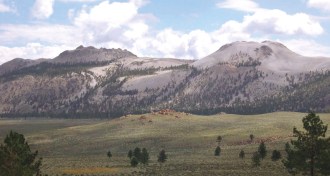
Supervolcanoes evolve superquickly
Huge underground chambers of magma appear and erupt within just several centuries, a study of California rocks suggests.
- Humans
Climate skepticism not rooted in science illiteracy
Cultural values are more important than science knowledge in shaping a person’s views on global warming.
- Animals
Bat killer hits endangered grays
The news on white-nose syndrome just keeps spiraling downward. The fungal infection, which first emerged six years ago, has now been confirmed in a seventh species of North American bats — the largely cave-dwelling grays (Myotis grisecens). The latest victims were struck while hibernating this past winter in two Tennessee counties.
- Humans
Harappans may have lived, died by monsoon
Waning of seasonal rains over millennia gave rise to a civilization and then doomed it, a new study suggests.
- Climate
Rising CO2 promotes weedy rice
There has been a lot of research, recently, showing how global change — especially warming — can alter the habitat and preferred range of marine and terrestrial species. But rising levels of greenhouse gases can also, directly, do a number on agricultural ecosystems, a new study shows. At least for U.S.-grown rice, rising carbon dioxide levels give a preferential reproductive advantage to the weedy natural form — known colloquially as red rice (for the color of its seed coat).