349 results
349 results for: exoplanet
- Astronomy
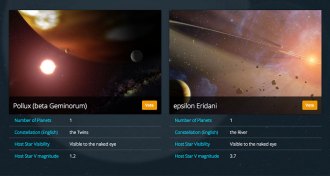
Choose Ninja, Cervantes or Rosalind as names for exoplanets
Names for 20 exoplanets are in the hands of a discerning online audience.
- Planetary Science
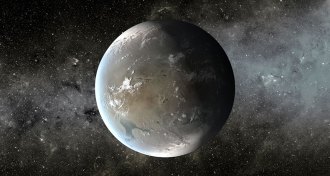
New exoplanet: Big Earth or small Neptune?
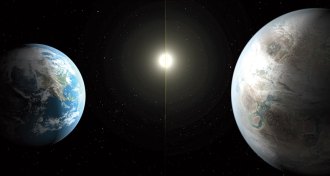
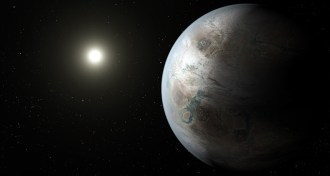
NASA’s Kepler spacecraft has discovered a “cousin” of Earth 1,400 light-years away. But even though the new planet bears many similarities to Earth, experts say much about it remains a mystery.
- Astronomy
Kepler telescope identifies new ‘habitable zone’ planet
A new analysis of data from NASA’s Kepler mission has uncovered a planet orbiting a sunlike star that could be Earth’s “cousin.”
- Health & Medicine
E-cigarette reports provide science that society craves
Research on vaping fills a crucial need in science’s service to society: providing the best information possible in a timely manner, so people can make wise choices.
- Astronomy
Big exoplanet may be surrounded by helium
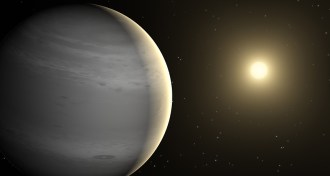
Warm Neptune-sized exoplanet might have atmospheres filled with helium.
- Astronomy
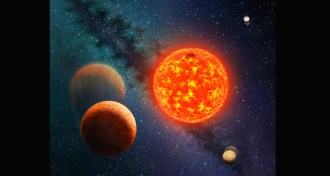
Mars-sized exoplanet is smallest to have its mass measured
The smallest exoplanet to be weighed is a hot, rocky cousin of the Red Planet.
- Astronomy
Super-Earths are not a good place for plate tectonics
The intense pressures inside super-Earths make plate tectonics less likely, new research suggests.
- Astronomy
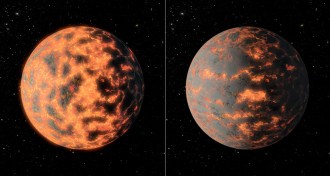
Erupting volcanoes may cause exoplanet’s temperature extremes
Temperatures fluctuate wildly on a nearby exoplanet, and volcanoes might be the culprit.
- Astronomy
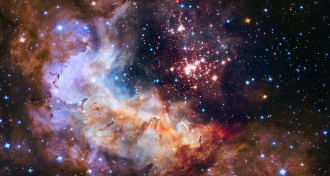
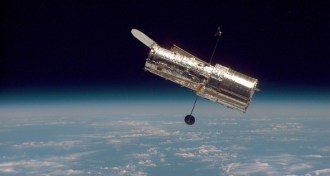
Astronomers celebrating Hubble’s past focus on its future
Astronomers celebrate the 25th anniversary of the Hubble Space Telescope by reflecting on its diversity and looking ahead to the future.
- Science & Society
One anniversary to celebrate, one to contemplate
In this issue, both feature articles focus on anniversaries, though of two very different kinds.
- Astronomy
Celebrating 25 years of the Hubble Space Telescope
The Hubble Space Telescope has served for more than two decades as the sharpest eyes ever to peer into the universe.
- Planetary Science
Earth, neighbors weren’t the first rocky planets in the solar system
Jupiter might have swept an earlier generation of rocky planets into the sun, leaving room for Earth and its neighbors to form.