5,553 results
5,553 results for: Forests
- Ecosystems
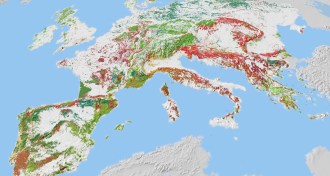
Aging European forests full to the brim with carbon
Trees' capacity to sequester carbon dioxide from the atmosphere is dwindling.
- Life
Natural antifreeze prevents frogsicles
Sugar and other chemicals keep Alaskan frogs from freezing completely.
-
From the January 4, 1930, issue
PILTDOWN MAN EARLIEST HUMAN BEING The ape-man of Darwin was read out of man’s family tree and the dawn-man of Sussex, older than 1,250,000 years, was elevated to the position of man’s progenitor by Dr. Henry Fairfield Osborn, president of the American Museum of Natural History, New York. A new picture was painted by Dr. […]
- Humans
From the April 5, 1930, issue
SPARROW-SIZE KINGFISHER The Celebes Wood Kingfisher (Ceycopsis fallax), shown on the cover of this week’s SCIENCE NEWSLETTER, is a bird scarcely as large as an English Sparrow. Similar kingfishers of tiny dimensions are found in various tropical countries. They are hunters as well as fishers and feed on insects and other life as well as […]
- Humans
From the May 10, 1930, issue
CANNON-BALL TREE The strange growth represented on the cover of this issue of the SCIENCE NEWS-LETTER is not a freak grapefruit tree. It is the normal method of flowering and fruiting of the cannon-ball tree, a member of the monkey-pot family found in the forests of South America. Its fruiting branches always grow out of […]
- Humans
From the May 24, 1930, issue
GRASSHOPPERS THREATEN UNITED STATES Grasshoppers threaten to wreak heavy damage to grain and forage crops in Montana and the Dakotas this year. There were many hoppers in these states, and in parts of Texas, last year, and the eggs they laid are now hatching in large numbers. If climatic and other conditions favor the growth […]
- Earth
Disaster Pix
If you’re one of those people who need to see the extent of intense weather events and great natural disasters–preferably as they are developing–this Web site is for you. Satellite images, provided by the National Oceanic and Atmospheric Administration’s Operational Significant Event Imagery division, portray hurricanes, dust storms, snowfall, forest fires, volcanic plumes, and much […]
- Humans
From the September 6, 1930, issue
alt=”Click to view larger image”> LIONS IN ALASKA Alaska, with its vast herds of caribou, its foxes and beaver, its mountain sheep and goats, and its great bears, black, brown, grizzly, and white, is one of the world’s game paradises; but 100,000 years ago, long before the slow-witted men who inhabited Europe thought to follow […]
- Humans
From the October 4, 1930, issue
alt=”Click to view larger image”> BORNEO MONKEYS IMITATE MEN WITH BOTH NOSE AND VOICE One of nature’s most striking living caricatures is the proboscis monkey that lives in the deep forests of Borneo. A group of these creatures shown as they appear in their home among the branches of a pongyet tree is on exhibition […]
-
From the March 21, 1931 issue
MUSHROOMS SUDDEN GROWTH FOLLOWS LONG PREPARATION Quick as a mushrooms growth, is the phrase we like to apply to sudden and unexpected developments. An oil town, a stock-market fortune, the reputation of the writer of a hit, are all referred to the mushroom standard of comparison. Yet the mushroom is no creature of magic, not-here […]
-
Kelp! Kelp!
We can’t see this forest for the seas, but several Web sites offer colorful introductions to the variety and complexity of kelp forests. The State University of New York at Stony Brook site presents a photo album of different kelp forests. The Monterey Bay National Marine Sanctuary pages summarize the ecology of these complex ecosystems. […]
-
From the August 8, 1931 issue
TWO ARISTOCRATIC LADIES EMERGE FROM RETIREMENT There is something about newly-emerged silkworm moths that makes one think of the ladies of Cathay or Cipangu, long ago and far away, clothed in silk spun by ancestors of todays silk worms. In the cover picture of this weeks Science News Letter, Cornelia Clarke has made an admirable […]