Screwworm neutralizer: insect sterilization
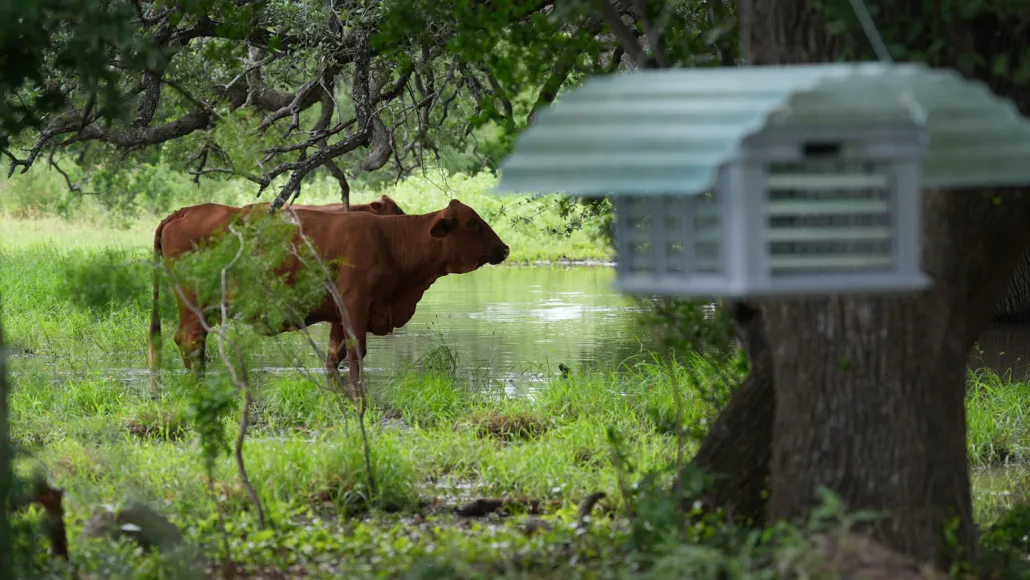
On a ranch near La Pryor, Texas, a sterile fly dispersal station from the U.S. Department of Agriculture is strategically placed near cattle. The release of sterile males is one way officials are trying to combat the spread of New World screwworm.
Eric Gay/AP Photo
By Susanna Camp
The New World screwworm (Cochliomyia hominivorax) is back in the United States for the first time in decades, and it is every bit as unwelcome as its name suggests. This parasitic fly lays its eggs in the open wounds of warm-blooded animals, where they hatch into flesh-eating larvae that can devastate livestock, pets, wildlife and — thankfully rarely — humans. But in a nice twist of biological fate, the females of the species only mate once in their lifetime, making them perfect candidates for sterilization intervention. For SN, Fechi Inyama describes the mating disruption game called the Sterile Insect Technique.
🦟 The science of sterile swarms
The strategy makes sterile males by exposing immature flies to radiation, and then letting them loose via aerial drops or from specialized chambers on the ground. Wild females are effectively “tricked” into a reproductive dead end. Decades ago, this method successfully pushed the pest down to South America, but now it’s returned as far north as Texas and New Mexico. To stop the spread, the U.S. Department of Agriculture is ramping up production. The original sterilization technique makes sterile males and females, but a new technology awaiting regulatory approval, called NovoFly, makes only males, in essence doubling the fly supply. The last U.S. eradication required 500 million sterile flies per week, enough to create a biological barrier against further northward movement.
🏭 The “fly factory” industrial complex
Developing the infrastructure to breed half a billion flies a week requires both government funding and private sector engineering. The USDA is currently investing more than $750 million into a massive domestic “fly factory” at Moore Air Base in Edinburg, Texas, working alongside the U.S. Army Corps of Engineers. This facility will make 300 million sterile flies weekly. It will require precise climate control, automated feeding systems and specialized sterilization equipment. Beyond internal government construction, the USDA’s “New World Screwworm Grand Challenge” has funneled $105 million into 40 different projects. Universities and biotech firms are using the funds to innovate everything from AI-assisted surveillance to next-generation lures and fly sterilization protocols.
☠️ The eradication ecosystem
The fight against screwworm has moved beyond traditional government programs into an arena ripe for biotech intervention:
- Agragene: A St. Louis–based biotech firm participating in the USDA’s Grand Challenge, Agragene uses gene editing (as opposed to the traditional method, radiation). In addition to their work combating the screwworm, they’ve partnered with Pairwise to access its CRISPR platform to control spotted wing drosophila (Drosophila suzukii), an invasive fruit fly that devastates berry crops. The company has raised more than $5 million.
- Flyttr: This Oxford, England–based pest management company owned by life sciences company Precigen (Nasdaq:PGEN), is partnering with the Texas Biomedical Research Institute on screwworm elimination. They’ve also deployed pest sterilization projects in Brazil and East Africa. The company has raised more than $65 million.
- M3 Agriculture Technologies: The company’s units for Sterile Insect Technique, drone deployment platforms and integrated pest management support provide a scalable framework for outbreak control and agricultural resilience. They’ve worked with the USDA on targeting the codling moth (Cydia pomonella) and navel orangeworm (Amyelois transitella) in specialty crops, such as apples, pears, almonds and pistachios. This private company’s most recent grant of $1 million was in 2023, and they report revenues of more than $700,000 annually.
The screwworm might just be, well, you know.
Disclaimer: The Science News Investors Lab newsletter is for informational purposes only and does not constitute investment advice. Society for Science and Science News Media Group assumes no liability for any financial decisions or losses resulting from the use of the content in this newsletter. Society for Science and Science News Media Group do not receive payments from, and do not have any ownership or investment interest in, the companies mentioned in this newsletter. Please consult a qualified financial advisor before making any investment decisions.