Uterus transplants can provide a path to pregnancy and parenthood
The latest case series reports good results for moms with donated wombs and their babies

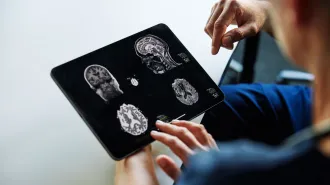
A uterus transplantation can make it possible for a woman lacking this organ to experience pregnancy.
d3sign/Moment/Getty Images
Around one in 500 women don’t have a functioning womb, needed to carry a pregnancy. This condition, called absolute uterine factor infertility, occurs when a woman is born without a uterus, has had to have it removed or has a defective organ.
For women with this type of infertility who would like to experience pregnancy, researchers and clinicians have developed a new surgical procedure: uterus transplantation. In 2014, the first birth after this procedure took place in Sweden, with the first U.S. birth after uterus transplantation three years later. In the last decade, more than 70 babies have been born globally following this surgery. The uteruses come from both living and deceased donors.
Uterus transplant surgeon Liza Johannesson was part of the team in Sweden that led to the first birth. She then moved to Baylor University Medical Center in Dallas, joining the group that subsequently reported the first U.S. birth. She and her colleagues describe how women and babies have fared after the procedure in the largest case series to date, reported in the Journal of the American Medical Association on May 1.
From 2016 to 2026 at Baylor, which has the largest uterus transplant center in the world, 44 women had the procedure. A month after the surgery, 37 had a successfully transplanted uterus. As of April 2026, 33 of those women have had embryos transferred. Thirty-one of those women became pregnant, with 27 giving birth so far. Eight of those women experienced complications, most commonly gestational diabetes or high blood pressure, which can happen in any pregnancy.
Of the 27 who gave birth, 23 had one child, and four had two children each. All newborns had a health score, or Apgar score — which assigns points to health measures including heart rate and breathing immediately after birth — of at least 7 out of 10 at five minutes. Eleven of the newborns were admitted to the neonatal intensive care unit due to being born prematurely, with stays ranging from a few days to almost two months.
“These women that are told they would never carry a pregnancy — to see them go through that pregnancy and childbirth, it’s extraordinary,” Johannesson says. She and her colleagues talked to women about their motivations for undergoing uterus transplantation at Baylor, for a study published in 2021 in the American Journal of Surgery. Study participants spoke of the desire to carry a pregnancy and to help others who might benefit from the procedure. “I wanted to be able to look down and see my belly growing and feel my baby kick,” one participant said. Another added, “Even if it doesn’t work for me, I wanted to be able to move forward with research” for others with absolute uterine factor infertility.
Science News spoke with Johannesson about the procedure, including how the field has grown and the steps for organ recipients and donors. The interview was edited for length and clarity.
SN: How has uterus transplantation progressed over time?
Johannesson: It’s working with increasing reliability. Most transplants are successful and among those patients with a functioning uterus that’s viable 30 days after the transplant, the majority actually go on to have a healthy baby. That’s really the key shift, that once a uterus takes, the chances of pregnancy and live birth are really strong. We’ve gone from a very experimental procedure to something that we now offer clinically to patients.
SN: Who is eligible for a transplant?
Johannesson: We transplant women that have something called absolute uterine factor infertility and that really means that the uterus is the problem, that’s why they can’t carry a pregnancy or give birth. To be a candidate, you also have to be pretty healthy in general [and] between the ages of 18 and 40. We are not strict on the 40, but we don’t want older than 45 for sure, because that adds a lot of extra stress and a lot of extra risk to the procedure.
SN: What would a patient’s experience from transplantation to pregnancy look like?
Johannesson: It all starts with IVF [in vitro fertilization]. The patients create and freeze embryos prior to the transplantation. We don’t want to transplant someone without having the possibility of fertilization because that’s the whole point. Then you come to the transplant surgery itself. That is a complex surgical procedure but, in short, it involves connecting the uterus to blood vessels and the vaginal canal of the recipient. Even if you are born without a uterus, you have a vagina and you have all of the pelvic vessels. I do a gynecological examination on them afterward. If I didn’t know, I would never be able to tell that that uterus wasn’t there from the beginning because it looks completely normal.
Usually, [recipients] begin having periods within a couple of months, which is the first sign that the uterus is functioning. From there, we move to the first embryo transfer, around three months after the transplantation itself. If pregnancy occurs then it’s closely monitored and then we deliver by C-section [cesarean section]. Some of the recipients don’t want another pregnancy or they haven’t reacted so well on the immunosuppression or [there are] medical complications, so we take the uterus out. But many of them want to go for a second and maybe even a third pregnancy. The important thing is that we do take the uterus out after the journey is done because we don’t want them taking immunosuppression drugs for the rest of their lives.
SN: Who are the donors?
Johannesson: We have had both living and deceased donation. We thought we were going to do fifty-fifty but when we started so many living donors from all over the U.S. contacted us and really wanted to give their uterus to someone. So it turned out that we are doing almost exclusively living donors.
We interviewed those donors [about] what’s the motivation to do this. This was the common thread through all of them: that pregnancy and childbirth was such an important thing in their own lives that they wanted to donate that to someone else. They’re not donating an organ per se, almost an experience to someone else.
SN: How do women do after uterus transplantation, pregnancy and birth? And infants?
Johannesson: Broadly speaking, when a transplant uterus is functioning, the live birth rates are the same that we see in IVF. We see similar complication rates right now as we see in IVF pregnancies. We do monitor [the recipients] closely because we want to make sure the immunosuppression is right. Then in terms of the health of the baby we have a very good outcome. There’s no one that had malformations or anything that’s tied to the transplant itself. There’s a little bit higher risk of prematurity than the general population but not more than IVF pregnancies or solid organ transplant patients in general.
SN: What’s needed to continue to move the field forward and increase availability?
Johannesson: We are working a lot on getting a standardized protocol so that outcomes are consistent across different centers. We do need the long-term data on both the mothers and the children. The first baby that was born was in 2014 in Sweden and the first one in the U.S. [was in] 2017, so they’re getting to that middle school age. We’re going to continue monitoring.
Also we need to make this procedure less resource intensive. We need to make sure that we can reach out to many women. In the beginning of the field, a lot of institutions paid for transplants. Eventually the money runs out. So far the insurance companies have no interest [in covering this]. Many insurance companies don’t cover IVF so it’s not only uterus transplant. We have a lot of work to do there because right now it’s a costly procedure and a lot of the patients have to pay a lot for themselves and that’s the last thing we want. We don’t want this to only be for the wealthy.