Quantum physics can confirm where someone is located

Entanglement can connect the digital world to the physical world
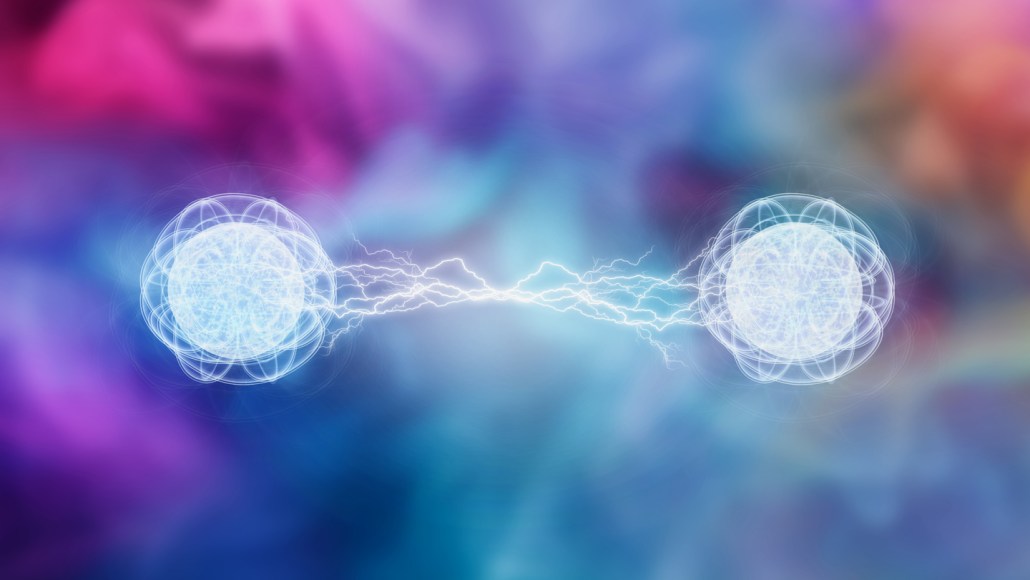
Two spheres on a colorful background connected by jagged lines

Entanglement, a quantum connection between two particles, is the basis for a variety of security techniques, including verifying someone’s location.

bymuratdeniz/iStock/Getty Images Plus

This is a human-written story voiced by AI. Got feedback? Take our survey . (See our AI policy here .)

DENVER — An urgent call comes in from the White House. But the recipient is skeptical: They need a way to verify that the message comes from the purported location. Quantum physics has a solution.

Scientists have demonstrated a quantum technique to ensure that someone is in the location they claim to be, physicist Abigail Gookin reported March 18 at the American Physical Society’s Global Physics Summit. Called quantum position verification, the technique is based on the concept of quantum entanglement, in which the fates of two far-flung particles are closely linked.

In the future, the technique could be useful for preventing some types of phishing attacks, or for limiting which users can access certain resources. (For example, access to sensitive nuclear weapons infrastructure could be restricted to those in a secure government building.) The method could be part of a future quantum internet that could one day provide various types of ultrasecure communications.

Here’s how it works: Two people, called verifiers, each want to confirm that a third person, called a prover, is in a given location. The verifiers, who are on opposite sides of the prover’s purported location, each send a random number to the prover, which the prover will use to determine their next step. Meanwhile, one of the verifiers creates a pair of entangled photons, or particles of light. The verifier holds onto one photon, and sends the other to the prover.

The prover and verifier measure their photons simultaneously. Specifically, they measure polarization, the direction in which the electromagnetic waves of the photons wiggle. The random numbers tell the prover what measurement settings to use to determine their photon’s polarization. The prover sends the result of their measurement back to the verifiers.

Then, the verifiers compare the prover’s result to the result from the measurement of the other photon. Over many repetitions of this photon-measuring protocol, the results should be strongly linked, or correlated. If a sneaky impostor intercepted the photon from another location, the results of the measurements wouldn’t be as strongly correlated as expected, thanks to constraints set by the speed of light and quirks of quantum measurements. The verifiers would know that something was fishy.

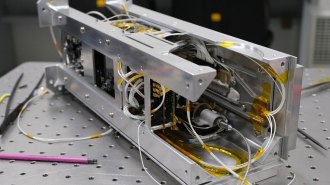
At the National Institute of Standards and Technology (NIST) in Boulder, Colo., scientists created two verifier stations, separated by about 200 meters and connected by optical fibers to a prover in between. The method successfully localized the prover, Gookin, of NIST, and colleagues reported in a paper submitted January 23 to arXiv.org.

The basis for the technique is what’s called a loophole-free Bell test, a method of sending and measuring quantum particles that proves that the oddities of quantum physics can’t be explained away. That’s because the correlations between pairs of photons are stronger than any classical theory could account for.

Because the technique connects a real, physical place to information the parties exchange, it could be the basis for other secure communication techniques going forward says Gookin. “This is the first time we can concretely tie someone’s location to their information.”

Senior physics writer Emily Conover has a Ph.D. in physics from the University of Chicago. She is a two-time winner of the D.C. Science Writers’ Association Newsbrief award and a winner of the Acoustical Society of America’s Science Communication Award.