News
-
EnvironmentReplacement for toxic chemical in plastics, receipts may be just as toxic
Mounting evidence suggests that BPS, a common chemical in plastics, may cause the same health effects as BPA.
By Beth Mole -
EarthTethys Ocean implicated in Pangaea breakup
The shrinking of the Tethys Ocean may have broken up the Pangaea supercontinent.
-
PhysicsHigh-temperature superconductivity record awaits confirmation
A hydrogen-sulfur compound under pressure may transport electrical current with no resistance at a record high temperature.
By Andrew Grant -
Planetary ScienceDawn spacecraft arrives at dwarf planet Ceres
The Dawn spacecraft arrives at Ceres to begin a 14-month investigation of the dwarf planet.
-
Quantum PhysicsLight trick can retrieve missed messages
Even if photons pass you by, you can still snatch a signal from their electromagnetic wake, physicists propose.
By Andrew Grant -
AstronomySupernova hurls star out of the galaxy
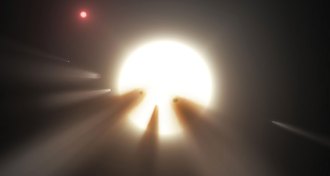
The fastest-moving star to leave the Milky Way might have been launched by a nearby exploding star.
-
AnimalsKiller whales follow postmenopausal leaders
Taking the lead on salmon hunts may be postmenopausal killer whales’ way of sharing their ecological knowledge.
By Susan Milius -
Health & MedicineHepatitis E vaccine shows strong coverage
A large trial in China indicates that a vaccine can provide 87 percent protection against the hepatitis E virus, which infects 20 million people a year.
By Nathan Seppa -
HumansAncient jaw may hold clues to origins of human genus
A 2.8-million-year-old fossil from Ethiopia raises questions about the origins and evolution of the human genus, Homo.
By Bruce Bower -
NeuroscienceBrain cells predict opponent’s move in game-playing monkeys
Newly discovered brain cells help monkeys predict whether a companion will cooperate.
-
PlantsTropical plant knows whose bill is in its flowers
A rainforest plant avoids inbreeding by accepting pollen only from hummingbird species that must travel to reach it.
-
Quantum PhysicsTrying to get the down-low on gravity
A twist on a classic quantum mechanics experiment could lead to the discovery of elusive gravitons.
By Andrew Grant